Google this week announced a hardware initiative
to design and build new quantum information processors based on
superconducting electronics. The effort is related to the
launch last year of its Quantum Artificial Intelligence Lab.
Physicist John Martinis, winner of the 2014 Fritz London Memorial
Prize, leads a group of scientists from the University of California at
Santa Barbara who will collaborate with the Google team. "This is very exciting that John Martinis' group will join the Google
effort," said Raymond Laflamme, Canada Research Chair in quantum
information and executive director for the University of Waterloo's
Institute for Quantum Computing. "John has been a leader in the way of building a quantum computer
with superconducting qubits," he told TechNewsWorld. "This might well
give a quantum computer on a timescale much shorter than what people had
thought."
A 1,000-Qubit Processor
Google's Quantum Artificial Intelligence Lab, which is hosted by NASA's
Ames Research Center, already houses a quantum computer from D-Wave
Systems with the goal of studying how quantum computing might advance
machine learning.
Now, "with an integrated hardware group, the Quantum AI team will be
able to implement and test new designs for quantum optimization and
inference processors based on recent theoretical insights as well as our
learnings from the D-Wave quantum annealing architecture," explained
Google Research Director of Engineering Hartmut Neven.
Google will continue to collaborate with D-Wave scientists and to
experiment with the existing machine at NASA Ames, which is due to be
upgraded to a 1,000-qubit Washington processor, Neven added.
Better Models
Google's interest in quantum computing stems from its belief that the
technology may be the key to solving some of the world's most
challenging computer science problems, especially in machine learning.
"Machine learning is all about building better models of the world to
make more accurate predictions," Neven said when the Quantum Artificial
Intelligence Lab was announced. "If we want to cure diseases, we need better models of how they
develop. If we want to create effective environmental policies, we need
better models of what's happening to our climate. And if we want to
build a more useful search engine, we need to better understand spoken
questions and what's on the Web so you get the best answer," he said. Traditional computers don't handle such problems well, Neven pointed
out, but quantum computing "lets you cheat a little" on the way to an
optimal solution.
A 5-Qubit Array
Quantum computers are thought to have the potential to be millions of
times more powerful than today's supercomputers are, though that
supposition
isn't without its skeptics. Nevertheless, Martinis' UCSB team earlier this year advanced quantum computing significantly by
demonstrating a new five-qubit array. "Qubits" -- short for "quantum bits" -- are a critical part of
quantum computers that take advantage of the multiple states of quantum
phenomena.
New Design
"Though quantum computing is still in its infancy, its potential is
significant enough to justify sustained effort and investment," said
Charles King, principal analyst with Pund-IT. Given that some early systems have not performed as well as hoped,
Google's investigation of a new processor and system design seems
warranted, he told TechNewsWorld. Security applications are one of the most oft-cited uses for quantum
systems, King pointed out. In addition, "the polynomial improvements in
performance projected for these systems compared to traditional
solutions would make them valuable for performing a variety of
simulations, including quantum physical processes."
New Process
"To have an operating environment able to take advantage of quantum
effects would be amazing," said Roger Kay, founder and president of Endpoint Technologies Associates. "The ability to take account of parallel logical paths would make
some computing problems more solvable, or solvable closer to real time,"
he told TechNewsWorld.
The development cycle "will be very long," Kay added, and "the
engineering is going to be overwhelming to get something like this into
production at a reasonable cost -- a whole new semiconductor process
that has yet to be created."
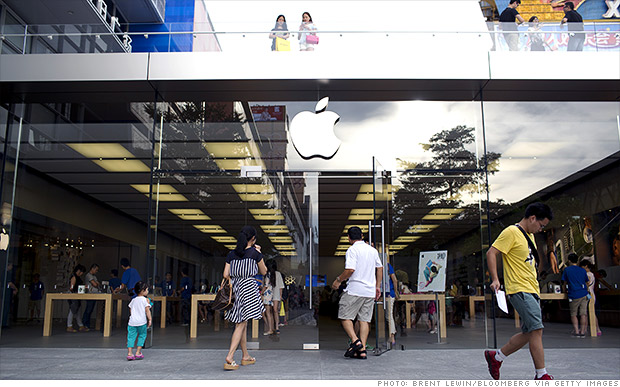
Less than a week ahead of the likely launch of Apple's
next-generation iPhones, the company is once again facing scrutiny over
its labor sourcing in China.
The watchdog group China Labor
Watch said Thursday that a factory in the Chinese city of Suqian that
makes metal iPad covers was guilty of a number of workplace violations,
including excessive hours, inadequate safety training, locked exits and
inadequate ventilation.
CLW said it had investigated the facility last month
after previously visiting it in April 2013, when it found "many of the
same violations."
Last year, CLW shared our investigative results with Apple, and the
company said that it would correct the safety and labor rights
violations at Catcher," CLW executive director Li Qiang said in a
statement. "This time, we are making our findings public, in an
effort to reduce the exploitation of Chinese workers making Apple's
products." Apple (AAPL, Tech30)
disputed the claim that it had ignored problems at the facility, saying
it undertakes frequent audits of the site that have resulted in safety
improvements. The company said it already had a follow-up audit of the
facility scheduled for next month, but has "dispatched a team there
immediately to investigate this report."
Will BlackBerry gain from Apple iCloud woes?
"Last year we conducted 451 audits deep into our supply chain so we
could uncover problems and work with our suppliers to fix them, and we
make it a priority to investigate every specific concern brought to our
attention," Apple said. The factory in question is operated by
Taiwan-based Catcher Technology. Catcher spokesman James Wu said the
company is "deeply concerned about the claims made by China Labor
Watch."
"We are committed to following Apple's supplier code of conduct and will investigate thoroughly," Wu said. The Catcher facility has also supplied tech companies including Dell, Hewlett-Packard(HPQ, Tech30), Lenovo, Sony(SNE), HTC and Motorola, CLW said.
A Dell spokesman said the PC maker was "working with Catcher to address issues."
"Any reports of poor working conditions in Dell's supply chain are
investigated and appropriate action is taken," Dell said. "Dell expects
our suppliers to employ the same high standards we do in our own
facilities."
Motorola said it does not currently work with
Catcher. The other companies did not immediately respond to requests for
comment. Apple has faced frequent scrutiny in recent years over labor conditions at its Chinese suppliers.
Last year, China Labor Watch raised concerns over allegedly excessive work hours at a pair of Apple suppliers.
Foxconn, another major Apple supplier China, has also been in the spotlight in recent years. A spate of suicides at Foxconn factories in 2010 garnered media coverage of allegedly unsafe facilities and excessive overtime.
Apple has been aggressive in its public response to the criticism. In
January 2012, the company signed up with the Fair Labor Association, an
independent labor-rights group, which promptly began inspections of the
working conditions at Foxconn's many factories. Apple is
currently the only tech company that's part of the Fair Labor
Association, and it says its suppliers "must live up to the toughest
standards in the industry if they want to keep doing business with
Apple."